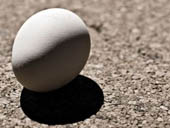
Rubbery Egg

Purpose

To demonstrate the importance of calcium for healthy teeth and bones.


Additional information

Calcium is the chemical element with the atomic number 20 and the CA symbol. It’s the 5th most abundant element by mass in the earths crust.

An important component of a healthy diet, calcium is essential for healthy and strong teeth and bones. Long-term calcium deficiencies can lead to numerous medical conditions and problems, including rickets, poor blood clotting, and possibly ostereoporosis. Furthermore, life-term deficiencies can lead to impaired kidney function, poor bone formation, and poor teeth formation.

High sources of calcium exists in milk, cheese, and other diary products. Some people, however, are lactose intolerant or avoid milk-based products for ethical and health reasons (such as Vegans). Fortunately, there are many good sources of calcium that exist beyond dairy products. These sources include seeds and nuts (like almonds), kelp and wakame (types of seaweed), oranges, figs, okra, and calcium fortified products such as orange juice or soy milk. One other source that's high in calcium that is often overlooked is the eggshell, which can be ground into powder and mixed with other foods.


Our Sponsors


Required materials

  • 1 egg
  • Drinking glass
  • Vinegar

Estimated Experiment Time

Several days (at least 3)


Step-By-Step Procedure

  • 1. Gently place the egg in the empty drinking glass
  • 2. Pour the vinegar over the egg until it's completely covered
  • 3. Wait several days and take the egg out of the vinegar

Note

It's important to wait out the experiment and not disturb the egg before it's time to remove it. After 3 or 4 days the egg will be ready for observation and handling and your patience will pay off.


Observation

What do you think is happening to the egg while it's submerged in the vinegar? What part do you think the vinegar plays in causing the egg to form its rubbery state?


Result

The vinegar reacts with the calcium in the eggshell, causing the calcium it to dissolve. This makes the shell rubbery. This shows the importance of calcium to make the shell strong, just like our bones. So, the next time you reach for a soda, think of this experiment and grab a glass of milk instead!


Additional Resources


Take a moment to visit our table of Periodic Elements page where you can get an in-depth view of all the elements, complete with the industry first side-by-side element comparisons!


Your email:
Your name:
Recipient email:
Recipient name:
Message:
 

Print this page   Bookmark this page  

Hide/View all projects Hide all projects Hide/View all projects

All Projects List

  • Accelerate Rusting
  • Acids And Bases
  • Additive Colors
  • Ant Microphotography
  • Apple Mummy
  • Balloon Rocket Car
  • Barney Banana
  • Bending Water
  • Bernoulli’s Principle
  • Blind Spot in Vision
  • Boiling Point of Water
  • Build an Inclinometer
  • Caffeine And Typing
  • Candy Molecules
  • Capillarity of Soils
  • Checking vs. Savings
  • Clean Cleaners
  • Cleaning Oil Spills
  • Climbing Colors
  • Cloud Cover
  • CO2 & Photosynthesis
  • Collecting DNA
  • Colorful Celery
  • Colors And Temperature
  • Composition of a Shell
  • Computer Passwords
  • Corrosiveness of Soda
  • Create a Heat Detector
  • Create Lightening
  • Cultivate Slime Molds
  • Desalinate Sea Water
  • Detergents and Plants
  • Dissolving in Liquids
  • Dissolving Solutes
  • Distillation of Water
  • Double Color Flower
  • Egg in a Bottle
  • Enzyme Activity
  • Eroding Away
  • Evaportating Liquids
  • Expanding Soap
  • Extracting Starch
  • Fans And Body Temp
  • Fertilizer & Plants
  • Filtration of Water
  • Floating Ball Experiment
  • Floating Balloon
  • Fog Formation
  • Font and Memory
  • Food and Academics
  • Friction And Vibration
  • Fruit Battery Power
  • Full and Low Fat Foods
  • Galileo's Experiment
  • Gas To Liquid
  • Grape Juice & Cleaners
  • Gravity and Plants
  • Green Slime
  • Growing a Crystal
  • Growing Bread Mold
  • Haemoglobin Binding
  • Hard vs. Soft Water
  • Homemade Floam
  • Home-made Geodes
  • Home-Made Glue #1
  • Homemade Snowflakes
  • Home-made Stethoscope
  • Homemade Volcano
  • Human Battery Power
  • Inertia of an Egg
  • Information and CD’s
  • Invisible Ink
  • Isolation of DNA
  • Jar Compass
  • Lemon Floaties
  • Levers And Force
  • Lift an Ice Cube
  • Light Colors and Plants
  • Long Lasting Bubbles
  • Magic Balloons
  • Magnified Light
  • Make a Compost Pile
  • Make a Fuse Model
  • Make a Parallel Circuit
  • Make An Elevator
  • Make Limestone
  • Make Objects Float
  • Make your own sundial
  • Matchbox Guitar
  • Math and Gender
  • Mean, Median and Range
  • Measuring Air Pollution
  • Mentos Soda Volcano
  • Microbial Contaminants
  • Milky Plastic
  • Mini Greenhouse
  • Missing Reflection
  • Molls Experiment
  • Music and Plants
  • Musical Bottles
  • Nocturnal Plants
  • Ocean Life & Oil Spills
  • Ocean Temperature
  • Optical Mice
  • Oral Bacteria
  • Orange Water Volume
  • Organic vs. Inorganic
  • Osmosis
  • Oxygen & Photosynthesis
  • Paper Bridge
  • Paper Marbling
  • Pascal’s Law
  • Play-Doh and Volume
  • Preserve Spider Webs
  • Pressure Volcano
  • Pulse Rates
  • Pythagorean Tuning
  • Refraction in Water
  • Rollercoasters & Loops
  • Rubber Heat Reaction
  • Rubbery Egg
  • Rust and Moisture
  • Search Engines
  • Secondary Colors
  • Seed Germination
  • Separate Salt And Pepper
  • Snappy Sounds
  • Soil Erosion
  • Soil vs. Hydroponics
  • Sound Waves
  • Spectrum through Water
  • Speed of Decomposition
  • Speed of Dissolving
  • Spore Prints
  • Static Electricity
  • Statistics and M&M’s
  • Stem-less Flowers
  • Super Strength Egg
  • Temperature and CPUs
  • Thirsty Rocks
  • Tornado Demonstration
  • Translucent Egg
  • Transpiration in Plants
  • Typing and Speed
  • Vibrating Coin
  • Volcanic Gas
  • Water and Living Things
  • Water Displacement
  • Water Evaporation
  • Water pH